



.png)
CASE: Why is it heating up? Gel, resin, vsp: the secrets behind your products
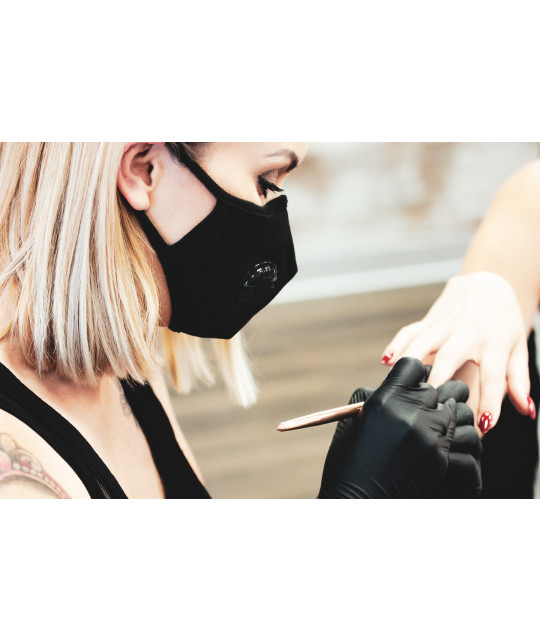
Whether gels or resins, the basic composition of the products remains the same. They are mainly composed of raw materials from the large family of acrylates. Each mixture is then supplemented with various additives, depending on the desired properties of the final product.
Your technical products under the microscope
Gels, acrylic systems, polymerization, photo-initiators, heat spikes and Low Heat technology… here is a clear explanation of the mechanisms behind your technical products.
Whether we are talking about gels or acrylic systems, the base composition of the products remains largely the same. They are mainly composed of raw materials belonging to the acrylate family. Depending on the properties required in the final product, the formulation is then completed with different additives.
What is polymerization?
The hardening mechanism of the material — whether gel or acrylic — is called polymerization.
When the product is delivered, it exists as very small individual molecules invisible to the naked eye, called monomers.
When polymerization begins, these monomers link together in multiple directions to form very long chains called polymers.
The result is a dense, strong and stable molecular network.
How does polymerization work?
Like any chemical reaction, polymerization requires a trigger called an initiator.
| Product type | Initiator type | Trigger |
|---|---|---|
| Acrylic system | Chemical initiator | The liquid monomer |
| Gel | Physical initiator | UV radiation, specifically UVA |
This trigger starts the transformation of monomers into polymers.
The specific case of gel
For polymerization to start after UV exposure, a photosensitive component must be added to the gel formulation.
This ingredient is called a photo-initiator.
It absorbs UV light and converts it into energy, which triggers the bonding of monomers together.
Without a photo-initiator, gel could remain exposed to UV for hours without curing.
Why does it heat up?
During polymerization, monomers link together to form polymers. This reaction releases energy and therefore produces heat.
In gel systems, the energy generated by the photo-initiator adds to this reaction, which can intensify the heat sensation.
Lamp power, wavelength and design also influence the heat spike produced during curing.
New generation lamps and Low Heat technology
With the evolution of formulas and increasingly powerful UV/LED lamps, manufacturers have developed Low Heat technologies to improve comfort during curing.
Low Heat does not reduce the lamp’s performance. Instead, it gradually increases power during the first seconds of exposure.
| Standard mode | Low Heat mode |
|---|---|
| Full power immediately | Gradual power increase |
| Faster heat spike | Smoother thermal rise |
However, heat cannot be completely eliminated, as it is inherent to the chemical polymerization reaction. Low Heat simply manages it better for improved comfort.
Key takeaway
Lamp quality, compatibility with the products used, proper curing times and correct application technique all play a crucial role.
Together, these factors ensure optimal, safe and long-lasting polymerization.
Comments
No comment at this time!
Leave your comment